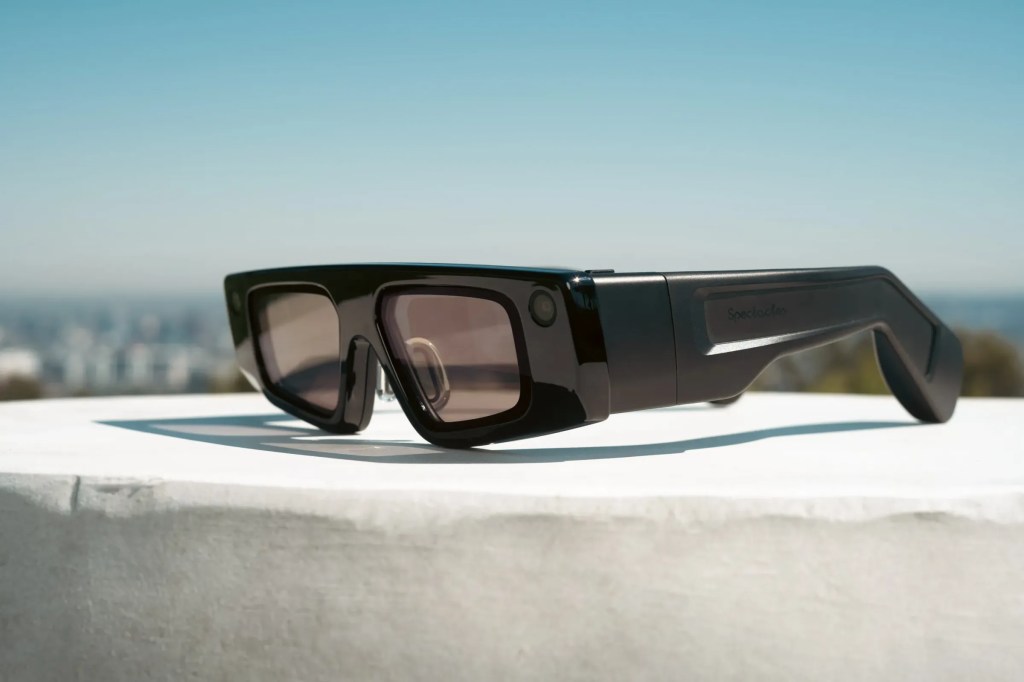
# Snapchat Spectacles: How Snap Helped Shape the Future of Smart Glasses
When people think about smart glasses today, companies like Meta, Google, and Apple often come to mind. However, one company has been quietly building the future of wearable computing for nearly a decade: **Snap**, the company behind Snapchat.
What started as a fun way to record videos has evolved into one of the most ambitious augmented reality (AR) projects in the technology industry.
## From Camera Glasses to Augmented Reality
Snap introduced the first Spectacles in 2016 as stylish sunglasses with built-in cameras that allowed users to capture moments from a first-person perspective and instantly upload them to Snapchat.
While the first generation was designed mainly for social media creators, Snap never viewed Spectacles as just a camera accessory. The company saw them as the beginning of the next computing platform.
Each generation introduced more advanced technology:
* Better cameras
* Improved microphones and speakers
* More powerful processors
* Hand tracking
* Voice controls
* Transparent augmented reality displays
Today, Spectacles have become true wearable computers rather than simple camera glasses.
## Snap’s Vision: Computing Beyond the Smartphone
Snap believes that people shouldn’t have to constantly look down at a smartphone screen.
Instead, digital information should naturally appear in front of your eyes exactly when you need it.
This concept is known as **augmented reality (AR)**, where digital objects blend seamlessly with the real world.
Imagine:
* Walking through a city with live navigation floating in front of you.
* Instantly translating signs in another language.
* Playing multiplayer AR games with friends.
* Learning while repairing equipment with interactive instructions.
* Using AI to identify objects simply by looking at them.
This is the future Snap has been investing in for years.
## Powered by Snap OS
One of the biggest breakthroughs is **Snap OS**, the operating system built specifically for Spectacles.
Instead of using traditional menus, users interact naturally through:
* Hand gestures
* Voice commands
* Spatial awareness
* AI-powered recognition
Developers can create immersive AR experiences called **Lenses**, allowing users to play games, collaborate, learn, or visualize digital objects directly in their surroundings.
## Artificial Intelligence Makes Spectacles Smarter
Artificial intelligence is becoming the heart of modern smart glasses.
Future Spectacles are expected to recognize objects, understand surroundings, answer questions, and provide contextual information without requiring users to pull out a phone.
For example, you could simply look at a restaurant and ask:
*”What’s the best-rated dish here?”*
Or look at a plant and ask:
*”Is this poisonous?”*
This combination of AI and AR could transform the way humans interact with information.
## The Consumer Era Begins
After several years of releasing Spectacles primarily to developers, Snap announced that lightweight consumer versions—now branded **Specs**—are arriving for the public.
This marks one of the biggest milestones in the wearable industry, placing Snap in direct competition with Meta, Google, Samsung, and Apple in the race to build the next generation of personal computing devices.
## Why Spectacles Matter
Snap’s greatest achievement may not be selling millions of glasses.
Instead, the company proved that augmented reality could move beyond smartphones and become something people wear every day.
Its investments in AR software, developer tools, spatial computing, and wearable hardware have influenced the entire smart glasses industry.
As artificial intelligence becomes more powerful and hardware continues to shrink, smart glasses are expected to evolve into everyday companions that help us communicate, navigate, work, and create.
The smartphone won’t disappear overnight, but wearable computing is steadily moving from science fiction to reality.
Snap Spectacles are one of the clearest examples of that transformation.
## Final Thoughts
Snap has spent nearly a decade refining its vision for wearable computing. What began as a pair of camera glasses has grown into an advanced augmented reality platform powered by AI, spatial computing, and intuitive interaction.
Whether Snap ultimately becomes the market leader or not, one thing is clear: Spectacles have helped shape the future of smart glasses, and the next chapter of wearable technology is only just beginning.
 gamingglasses
Plaats een reactie